



Why is a Wiped Film Evaporator (WFE) the Ideal Choice?
What is wiped film evaporator?
A wiped film evaporator (WFE), also called a thin film evaporator, is a type of distillation apparatus that creates a thin, rotating film of liquid on a heated surface to rapidly evaporate volatile components from a mixture, even with heat-sensitive, viscous, or fouling products. Key advantages include a short residence time, maximizing surface area for efficient heat transfer and minimizing thermal degradation. WFEs are widely used in industries like pharmaceuticals, chemicals, and food processing for purifying and recovering valuable components.
Application of Wiped Film Evaporator in Collagen Concentration Process
Requirement: Concentrate a 1.2%~1.5% collagen solution to 7%~9%, with a handling capacity of 200 kg/hour.
The material is heat-sensitive, and the concentration process must be controlled below 30°C. The viscosity pre- and post-concentration is close to that of water. Concentration is primarily achieved by evaporating a portion of the water to increase the collagen concentration.
Why is a Wiped Film Evaporator (WFE) the Ideal Choice?
The Wiped Film Evaporator is exceptionally well-suited for your described collagen concentration process. Its advantages are particularly for your material's properties (heat-sensitive, low temperature, low viscosity):
1. Excellent Heat Transfer Efficiency & Short Residence Time:
The WFE uses rotor blades to spread the material into a very thin, uniform liquid film (typically 0.5-1.0mm) on the heating wall, the evaporation surface area.
The residence time of the material inside the evaporator is extremely short, typically only seconds to tens of seconds**. This perfectly avoids the risk of denaturation, degradation, or loss of bioactivity that collagen might face under prolonged heating.
2. Low-Temperature Evaporation Capability:
The evaporation temperature depends on the vacuum level created by the system's very low absolute pressure. To achieve evaporation below 30°C, the system's absolute pressure only needs to be controlled at approximately 4.3 kPa (about 32.5 mmHg) or lower (because the saturated vapor pressure of water at this temperature is about 4.25 kPa). The WFE can achieve and maintain such a high vacuum level, ensuring evaporation occurs at the set low temperature.
3. Ability to Handle Viscosity Changes:
Although you mentioned the viscosity is close to water before and after concentration, it might increase slightly near the 9% concentration. The WFE's scraping system continuously agitates and renews the liquid film, effectively preventing material from fouling or scaling on the heat transfer surface, and ensuring stable flow and evaporation even for higher viscosity materials. This is crucial for guaranteeing continuous and stable production.
4. High Concentration Ratio:
A high concentration ratio can be achieved in a single pass. The concentration factor from 1.2% to 9% is 9 / 1.2 = 7.5 times. This is entirely achievable for a WFE. The required water evaporation rate is also significant, which highlights the WFE's high efficiency.
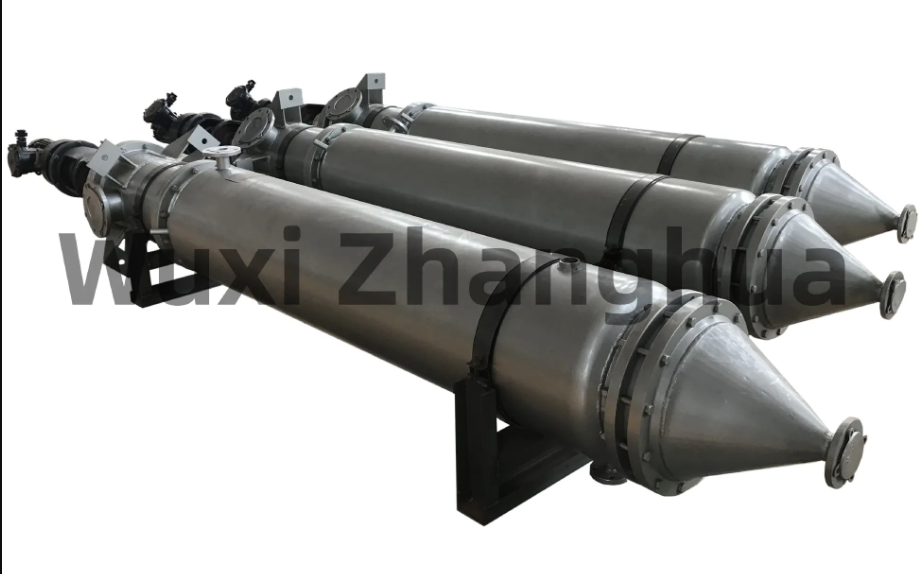
Key Process Parameter Design & Calculation (Based on your requirements)
1. Material Balance & Evaporation Rate:
Feed Flow Rate (F): 200 kg/h
Feed Concentration (Xf): Take average value 1.35%
Product Concentration (Xp): Take average value 8%
Let Product Flow Rate be P kg/h, Evaporated Water Rate be V kg/h
Total Mass Balance: `F = P + V` => `200 = P + V`
Solute (Collagen) Balance: `F Xf = P Xp` => `200 0.0135 = P 0.08`
Solving: `P = (200 0.0135) / 0.08 = 33.75 kg/h`
Then: `V = 200 - 33.75 = 166.25 kg/h
Conclusion: Approximately 166.25 kg/h of water needs to be evaporated.
2. Temperature & Vacuum Level Setting:
Target Evaporation Temperature ≤ 30°C
Corresponding Absolute Pressure: Consult steam tables, the saturated vapor pressure of water at 30°C is 4.246 kPa(approx. 31.9 mmHg).
System Design Pressure: To ensure evaporation occurs at 30°C or even lower, the system's operating absolute pressure should be slightly below 4.25 kPa. The design target is usually set at an absolute pressure of 3.0 - 4.0 kPa (approx. 22.5 - 30 mmHg). This requires a high-performance vacuum system (e.g., mechanical pump + Roots pump combination, or cold trap + steam ejector pump).
3. Heating Medium Selection:
The evaporation temperature is around 30°C, so the required heating medium temperature does not need to be very high, just sufficient temperature difference (ΔT) to drive heat transfer. Excessive ΔT may cause local overheating.
Recommended Medium:30-40°C warm water. This can typically use a circulating water system, controlling the water temperature via a plate heat exchanger using water from a cooling tower. The use of steam or high-temperature thermal oil is strictly prohibited.
Equipment Selection & System Configuration Suggestions
1. Evaporator Size Estimation:
An evaporation rate of 166 kg/h is small to medium scale for a WFE.
The heat transfer coefficient (K) is usually relatively high under low viscosity, high vacuum conditions. Assume K=2000 W/m²·K (a relatively conservative estimate).
The required heat transfer area (A) can be roughly estimated by the formula `A = Q / (K ΔT)`, where Q is the heat load and ΔT is the temperature difference between the heating medium and the product evaporation temperature (e.g., take 10°C).
This is a complex calculation requiring precise heat load calculation. Usually, equipment manufacturers perform professional calculations based on evaporation rate, boiling point rise, etc.
Empirical Estimate: For such operating conditions, a wiped film evaporator for sale with a heat transfer area of approximately 0.5 - 1.5 square meters might be suitable. The final size must be confirmed by the equipment supplier through precise process calculation.
2. Key System Components:
Preheater: Although low temperature is required, it is still recommended to preheat the feed to the operating temperature (e.g., 28-29°C) to reduce the thermal load on the main evaporator body and improve efficiency. A **plate heat exchanger should be used, with warm water as the heat source.
Evaporator Main Body:** Material recommended 316L stainless steel** to ensure cleanliness and corrosion resistance. The scraper blade design must be suitable for low-viscosity liquids.
Condenser: Use a plate or tubular condenser to fully condense the evaporated water vapor using chilled water (or cooling water). The efficiency of the condenser directly affects the system vacuum.
Vacuum System: This is one of the cores of the system. A combination of a "Liquid Ring Pump + Roots Pump" is recommended, or a combination of a "Cold Trap + Dry Screw Vacuum Pump" to achieve and maintain the required high vacuum under energy-efficient conditions.
Control System: Should be equipped with an advanced PLC or DCS system for interlocked automatic control of feed flow rate, heating medium temperature, and system vacuum level (i.e., evaporation temperature), ensuring stable process parameters and protecting the heat-sensitive material.
Brief Process Description
1. The 1.2%-1.5% collagen feedstock is stored in a feed tank.
2. The feedstock is transported by a feed pump to a plate preheater and heated to about 28-29°C.
3. The preheated liquid enters the top of the evaporator.
4. Inside the evaporator, the material is distributed into an extremely thin film by rotating scraper blades, and water rapidly evaporates below 30°C under high vacuum.
5. The concentrated collagen solution (7%-9%) is continuously discharged by a pump at the bottom.
6. The water vapor generated rises to the top of the evaporator and enters the condenser, where it is fully condensed.
7. The condensate (distilled water) is discharged by a condensate pump and can be recovered and reused.
8. The vacuum system continuously removes non-condensable gases from the system, maintaining the high vacuum environment.
Summary
For the requirement of concentrating 200 kg/h of collagen solution from ~1.35% to ~8% while operating below 30°C, the Wiped Film Evaporator is currently the most reliable and ideal technological choice. It perfectly meets all your requirements for heat sensitivity, low temperature, and high efficiency.
Next Steps:
Provide the above parameters and requirements to professional Wiped Film Evaporator manufacturers (excellent domestic or international suppliers). They can perform precise process calculations and provide you with a detailed technical proposal, equipment quotation, and specifications.

CONTACT US
Contacts: Peggy Zhang
Tel: 0086-510-83551210
Wechat: 86 13961802200
86 18118902332
WhatsApp: 86 13961802200
86-18118902332
WhatsApp: 1(805)869-8509
Email: zqz008@126.com,zhangpeijie@zhanghuayaoji.com
vincent_zhang@zhanghuayaoji.com
Address: Shitangwan Industrial Park, Huishan District, Wuxi, PRC
PLEASE CONTACT US.
We are confident to say that our customization service is outsatnding.