


Application of integrated filtering, washing and drying equipment in the production of fluorinated polyimide materials
Application of Filtering, Washing, and Drying industrial drying equipment in the Production of Fluorinated Polyimide Materials for Flexible Screens
Let's explore in detail the application of the filtering, washing, and drying "three-in-one" integrated filtration and drying equipment in the production of fluorinated polyimide (FPI) materials for flexible display panels (such as foldable phone screens).
Fluorinated polyimide is currently a core substrate or cover material in flexible display panels. The production process has extremely stringent requirements for high purity, high uniformity, and low defect rates, and the filtering, washing, and drying equipment is a core unit operation critical to ensuring these key metrics.
Brief Introduction to the Production Process of Fluorinated Polyimide (FPI)
FPI is typically synthesized using a two-step method:
1. Polycondensation Reaction: Fluorinated dianhydride and diamine monomers undergo polycondensation in a polar organic solvent (such as NMP, DMF, DMAc, etc.) to generate a solution of fluorinated polyamic acid (PAA).
2. Imidization Reaction: The PAA solution is coated and formed, then dehydrated and cyclized at high temperatures to form the final polyimide film.
Throughout this process, the purification and subsequent handling of the PAA solution are crucial for determining product quality, which is precisely where the filtering, washing, and drying equipment comes into play.
Specific Application Stages of the Filtering, Washing, and Drying "Three-in-One" Equipment in FPI Production
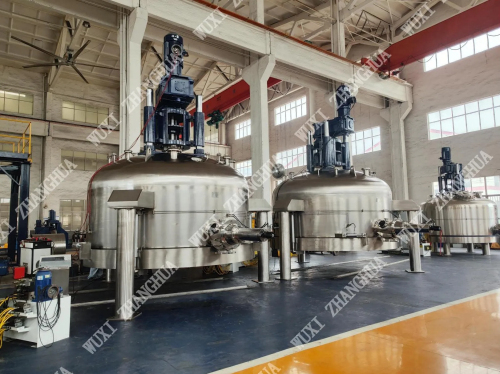
The "three-in-one" industrial drying equipment integrates the three processes of filtering, washing, and drying within a single sealed vessel. It is particularly well-suited for fine chemical processes like FPI production, which demand high requirements for the production environment (cleanliness, prevention of cross-contamination) and product consistency. Its main applications are in the following stages:
1. Application Stage: Purification of Polyamic Acid (PAA) Solution - Removal of Impurities and By-products
Purpose: After the polycondensation reaction, the crude PAA product solution may contain:
Trace amounts of unreacted monomers.
Catalyst residues (if used).
Small molecule by-products from the reaction (such as water, though the main solvent is organic).
Trace metal ion impurities (which are detrimental to the electrical performance and reliability of electronic devices).
Gel particles or insoluble matter.
Operation Process of the "Three-in-One" Equipment:
Filtering (Filtration): The PAA reaction solution is pumped into the main tank of the "three-in-one" filtration and drying equipment. Precision filtration is performed through the filter medium at the bottom of the equipment (such as precision sintered metal filter elements or plates) under pressure or nitrogen protection, effectively retaining all the aforementioned insoluble impurities and gel particles to obtain a clear, transparent PAA solution. This step is crucial for controlling appearance defects (like bright or dark spots) in the final flexible screen.
Washing: After filtration is complete, the filter cake (i.e., the retained impurities) accumulates on the filter bed. To further remove soluble impurities (such as metal ions, residual monomers), high-purity organic solvent (washing agent) is introduced to perform multiple steps of slurry formation, stirring, and re-filtration of the filter cake. Through washing and solvent displacement, impurities soluble in the washing agent are thoroughly removed and discharged. This step significantly reduces the ion content and ash content of the product.
Drying: After washing is completed, if the filter cake needs to be recovered (in some processes, it might be a form of the target product), the drying stage begins. Heating is provided via the equipment jacket using hot water/oil, while simultaneously applying vacuum or introducing high-purity nitrogen for bubbling and agitation, causing the solvent to evaporate and be recovered via a condenser. Ultimately, a dry, pure solid product is obtained. For PAA solution purification, this step is more commonly used for solvent recovery or waste residue treatment, as the main product is usually the purified filtrate solution.
2. Application Stage: Solvent Recovery and Waste Residue Treatment
The large amount of high-purity solvent used in the washing and drying processes can be efficiently recovered through the filtration and drying equipment's integrated condensation recovery system, reducing production costs and meeting environmental protection requirements.
The final dried waste residue (filter cake) has a small volume and stable form, facilitating centralized treatment as hazardous waste.
Core Advantages of the "Three-in-One" Equipment in FPI Production
1. Fully Enclosed Production: The entire purification process occurs within a completely sealed system, effectively preventing the intrusion of particulate contaminants (dust) and moisture from the environment, ensuring high product cleanliness. This is crucial for avoiding defects such as pinholes and cracks in flexible screens.
2. Prevention of Cross-Contamination: The equipment is designed with no dead legs, high surface finish (typically made of 316L stainless steel or polished), and complete CIP/SIP (Cleaning-in-Place/Sterilization-in-Place) capabilities. It is ideal for producing multiple types of high-value-added products, avoiding contamination between batches.
3. Improved Product Yield and Quality: The integrated design reduces the number of material transfers, thereby minimizing losses and contamination risks associated with exposure and adhesion, leading to higher product yield and ensuring batch-to-batch stability and consistency.
4. High Degree of Automation: The entire filtering, washing, and drying can be automated through PLC or DCS control systems, precisely controlling various process parameters (such as temperature, pressure, vacuum level, agitation speed, solvent volume, etc.). This reduces errors from manual operation and ensures process reproducibility.
5. Reduced Solvent Exposure, Ensuring Safety: The large quantities of organic solvents used in FPI production are often flammable, explosive, toxic, and hazardous. Enclosed operation significantly reduces operators' exposure to solvent vapors, enhancing production safety.
6. Saves Space and Energy Consumption: Integrating the functions of three pieces of high efficiency drying equipment into one saves factory floor space. Furthermore, thermal energy utilization is more efficient (e.g., heat from drying can be partially used for pre-heating in the washing stage), reducing overall energy consumption.
Special Considerations for Equipment Selection and Design
The "three-in-one" high efficiency drying equipment used for FPI production is not a standard product; it requires special design and selection based on process characteristics:
Material: Must be made of 316L stainless steel or higher grade materials. All product contact surfaces require high-precision polishing (such as EP/Electropolishing) to ensure no residue and corrosion resistance.
Sealing Performance: Sealing points such as shaft seals and valves demand extremely high standards, typically employing double mechanical seals with a barrier fluid system to ensure absolute leakage prevention.
Filtration Precision: The filtration elements (filter elements/plates) require extremely high precision, often needing to reach micrometer or even sub-micrometer levels to intercept very fine gel particles.
Cleanliness Requirements: The equipment design and manufacturing must comply with ASME BPE or similar pharmaceutical/electronic grade standards to ensure inherent cleanliness.
Explosion-Proof Requirements: Due to the handling of organic solvents, all electrical components, motors, etc., must meet explosion-proof standards (e.g., ATEX, IECEx).
Automation Control System: Needs to be equipped with an advanced automation control system capable of precisely recording and tracing all process parameters for each batch, meeting product quality traceability requirements.
Summary
In the production of fluorinated polyimide materials for flexible screens, the filtering, washing, and drying "three-in-one" integrated equipment is a key piece of apparatus for ensuring the final product achieves ultra-high electronic grade purity. It is primarily used in the precision purification process of the polyamic acid (PAA) solution. Through its characteristics of being fully enclosed, integrated, and highly automated, it efficiently removes impurities and particles that affect product performance, providing indispensable process support for producing defect-free, high-performance flexible display materials. Its value lies not only in the purification itself but also in laying a solid foundation for the **continuity, safety, stability, and traceability** of the entire FPI production process.

CONTACT US
Contacts: Peggy Zhang
Tel: 0086-510-83551210
Wechat: 86 13961802200
86 18118902332
WhatsApp: 86 13961802200
86-18118902332
WhatsApp: 1(805)869-8509
Email: zqz008@126.com,zhangpeijie@zhanghuayaoji.com
vincent_zhang@zhanghuayaoji.com
Address: Shitangwan Industrial Park, Huishan District, Wuxi, PRC
PLEASE CONTACT US.
We are confident to say that our customization service is outsatnding.